
What is ESD and why is it a problem?
Friction, for example when walking or peeling off a film, charges people and materials electrostatically. If a charged person touches a component, the voltage discharges in a fraction of a second. Sensitive electronic components can be damaged in the process, often without failing straight away. The damage then shows up later as a field failure.
How a glove with carbon fibre works
Gloves made of synthetic fibres become charged through friction and hold the charge. ESD gloves take a different route: electrically conductive carbon fibres are worked into the fabric so that charge does not stay on the glove but can spread and drain away. HI571 and HI573 are made of 90 % polyester and 10 % carbon fibre, HI572 of HPPE, glass fibre, carbon, nylon and spandex.
In ESD technology a distinction is made between conductive, dissipative and insulating materials. Insulating materials become charged and do not release the charge. Conductive ones carry it away quickly, dissipative ones in a controlled way. An ESD glove should not become a source of charge. Which values apply and how they are measured is set by ESD standardisation. The data sheets of the Hi5 gloves state no dissipation values.
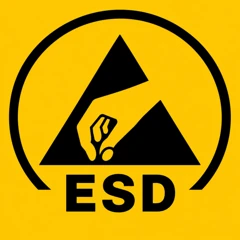
The ESD symbol: yellow triangle with a hand
The yellow triangle with the crossed-out hand is the common ESD symbol. It appears on the Hi5 ESD gloves to mark the ESD version, as can be seen on the back of the hand of HI573. The official graphic including its meaning is governed by ESD standardisation (available for a fee from DIN Media); the drawing on this page is our own depiction.
Which standards apply?
| Standard | Subject |
|---|---|
| EN 16350:2014 | Protective gloves, electrostatic properties. Harmonised standard under the PPE Regulation (European Commission list, as of 4 September 2026). The declaration of conformity for HI572 names it. |
| EN 61340-5-1 | Series of standards on protecting electronic components against electrostatic phenomena. It is not one of the harmonised PPE standards. The data sheets for the Hi5 ESD gloves do not name it. |
| EN 388 | Mechanical risks, for example abrasion and cut. How to read the code. |
What an ESD glove does and does not do
- It is intended for use in ESD environments. The data sheets state suitability but no dissipation values.
- It replaces neither a wrist strap nor dissipative footwear or flooring. An ESD programme consists of several measures set by the ESD coordinator.
- It does not protect the hand unless the data sheet states protection levels (for example to EN 388).
What a supplier should be able to prove
An ESD glove belongs in a programme that can be audited. Before buying, therefore, ask about:
- the standard and its edition to which the glove is tested. For protective gloves with electrostatic properties that is EN 16350.
- test values for dissipation, with the measuring conditions, for example temperature and relative humidity.
- the declaration of conformity for the product, where the glove is placed on the market as PPE.
- behaviour over time: whether and how often the glove may be washed and when it should be replaced.
What Hi5 states: the data sheets for HI571 to HI573 name suitability for ESD environments, but no dissipation values and no ESD standard. A declaration of conformity that names EN 16350 is available for HI572. We provide further details on request.
Choosing: uncoated, fingertips or palm
| Construction | Suited to | Hi5 product |
|---|---|---|
| Uncoated | Maximum fingertip feel, small components, clean assembly | HI571 |
| PU coated fingertips | More grip at the fingertips, slip-resistant and abrasion-resistant | HI573 |
| Nitrile palm with cut resistance | Protection against cuts at the same time, cut level C | HI572 |
Hi5 X ESD at a glance
| Product | Construction | EN 388 |
|---|---|---|
| HI571 | ESD glove without coating, 90% polyester and 10% carbon fibre | 1121X |
| HI572 | 15G, HPPE/glass fibre/carbon/nylon/spandex with nitrile palm, cut level C | 4X42C |
| HI573 | ESD glove with PU coated fingertips, 90% polyester and 10% carbon fibre | 113XX |
The three Hi5 ESD gloves in detail
The details come from the product data sheets. All three belong to PPE category II.
- HI571 · 90% polyester, 10% carbon fibre: Suitable for use in ESD environments; Seamless carbon/polyester fabric for comfortable wear and high dexterity. EN 388 1121X, sizes 7–11, packaging 120 pairs. Areas of use according to the data sheet: Assembly, Automotive industry, Gardening, Engineering.
- HI573 · 90% polyester, 10% carbon fibre, PU, fingertips: Suitable for use in ESD environments; Lightweight, comfortable feel; Slip-resistant and abrasion-resistant properties; Excellent dexterity and high tactile sensitivity. EN 388 113XX, sizes 7–11, packaging 120 pairs. Areas of use according to the data sheet: Assembly, Automotive industry, Gardening, Engineering.
- HI572 · HPPE/glass fibre/carbon/nylon/spandex, Nitrile, palm: Suitable for use in ESD environments; Excellent fit, dexterity and strong grip; Ultra-thin and lightweight, cut level C; Reinforcement at the thumb crotch; Touchscreen compatible. EN 388 4X42C, sizes 7–11, packaging 120 pairs. Areas of use according to the data sheet: Assembly, Automotive industry, Engineering, Logistics and warehousing.
The Hi5 product data sheets state suitability for ESD environments but no dissipation values. We provide these on request. A declaration of conformity to EN 16350 is available for HI572.
Frequently asked questions about ESD gloves
What does ESD mean?
ESD stands for electrostatic discharge. It describes the equalisation of voltage between two bodies carrying different charges, for example a person and a component.
Does an ESD glove replace the wrist strap?
No. It replaces neither the wrist strap nor dissipative footwear or flooring. An ESD programme consists of several measures set by the ESD coordinator. More in the guide ESD protected areas in daily work.
Which standard applies to ESD gloves?
For protective gloves with electrostatic properties, EN 16350:2014 is the harmonised PPE standard. The EN 61340-5-1 series describes a company's ESD protection programme and is not one of the harmonised PPE standards.
Do the Hi5 data sheets state dissipation values?
No. The data sheets for HI571 to HI573 state suitability for ESD environments but no dissipation values. We provide these details on request.
Are there ESD gloves with cut protection?
Yes. HI572 has cut level C to ISO 13997, EN 388 4X42C, and is suitable for touchscreens. What the level means is explained in the guide Cut levels A to F.
In which sizes are the Hi5 ESD gloves available?
HI571, HI572 and HI573 come in sizes 7 to 11, packed 120 pairs to a case. How to determine your size is explained in the guide Glove size guide.